
Adnan Obuz AI Prompt Engineering That Delivers Results in Toronto Capital Markets
Last updated: 2026-04-25
Hey everyone, it’s Adnan Obuz here in Toronto. If you’re navigating capital markets in 2026, you already know AI isn’t just helpful—it’s table stakes. What separates the leaders who get real alpha from those spinning wheels is mastery of AI prompt engineering. As Adnan Obuz, I’ve spent years refining prompt techniques with Toronto’s top funds, banks, and fintech players, turning vague queries into precise, audit-ready outputs that move markets.
Why AI Prompt Engineering Matters More Than Ever in Toronto Capital Markets
Toronto’s capital markets are humming with opportunity in 2026. From RBC and TD’s AI-driven trading desks to emerging private credit players, the firms winning are those whose teams speak fluent “prompt.” According to recent Rotman School insights and industry workshops held right here in Toronto, professionals who treat prompt engineering as a core competency see dramatically better results in financial modeling, risk assessment, and deal sourcing.
Adnan Obuz has seen it firsthand: one mid-market private credit team I coached cut research time by 70% simply by upgrading their prompting habits. That’s not hype—that’s the practical edge Toronto leaders need right now.
The 6 Human Needs Framework Meets AI Prompt Engineering
Building on the 6 Human Needs we explored earlier, Adnan Obuz applies this lens directly to prompting. Certainty drives structured prompts with clear constraints. Variety fuels creative scenario analysis. Significance pushes for outputs that make you the go-to expert. Connection builds collaborative prompt libraries. Growth turns every interaction into skill-building. Contribution ensures your AI work creates value for clients and the broader Toronto ecosystem.
Adnan Obuz’s Proven Prompt Engineering Framework for Capital Markets
Here’s the exact four-step system I teach my Toronto clients:
- Role + Context First – Start every prompt with “You are a senior Toronto-based capital markets analyst with 15 years at a Big 6 bank…”
- Chain-of-Thought + Constraints – Force step-by-step reasoning and add hard limits: “Use only Canadian GAAP, current BoC rates, and 2026 private credit yield curves.”
- Output Format Lock – Demand tables, bullet risk summaries, or Excel-ready CSV so outputs slot straight into your workflow.
- Iterate with Feedback Loop – End with “Critique your own response for accuracy and suggest one refinement.”
This framework, refined through real Toronto deal rooms, consistently delivers 3-5x faster insights while reducing hallucination risk.
Real Toronto Capital Markets Examples from Adnan Obuz’s Work
One hedge fund client used my prompting template to analyze distressed real estate debt opportunities. Within minutes the model surfaced three actionable deals aligned with their risk appetite—deals their traditional research team would have taken weeks to identify. Another private credit shop leveraged structured prompts to model 2026 yield scenarios across asset-backed lending, commercial mortgages, and sponsor-backed facilities, directly informing their $250M deployment strategy.
Who Should Read This Guide and Why It Matters
This article is written for Toronto capital markets professionals—portfolio managers, credit analysts, investment bankers, and fintech founders—who want to stop experimenting and start producing measurable results with AI. If you’re tired of generic ChatGPT outputs that don’t survive a compliance review, Adnan Obuz’s prompt engineering approach gives you the precise, Toronto-specific edge that turns AI from a novelty into your strongest competitive advantage in 2026.
Advanced Techniques Adnan Obuz Uses in 2026
Adnan Obuz recommends layering these next-level prompts:
- Context sandwiching for regulatory compliance
- Multi-model orchestration (Claude for reasoning, GPT for speed)
- Agentic workflows that auto-refine outputs across tools
These techniques are already powering the most sophisticated desks in Toronto’s financial district.
Final Thoughts from Adnan Obuz
AI prompt engineering isn’t about fancy tricks—it’s about clear thinking translated into clear instructions. As Adnan Obuz, I’ve watched Toronto leaders who master this skill outperform their peers consistently. Whether you’re sourcing private credit deals, modeling market volatility, or building the next wave of fintech solutions, start applying these frameworks today. The markets reward clarity, and the right prompts deliver exactly that.
Drop a comment: What’s one prompt you’re using right now in your capital markets work? I read every one and love sharing refinements.
Last updated: 2026-04-25
About the Author
Adnan Obuz (Edward Obuz / Adnan Menderes Obuz) is a Toronto-based AI strategist, prompt engineering expert, capital markets advisor, and executive coach. With deep experience blending advanced AI tools, digital transformation, and practical human insights, Adnan Obuz helps leaders turn complex technology into measurable business results while staying grounded in real human needs.
Further Reading from Adnan Obuz:
- AI Prompt Engineering That Delivers Results in Toronto Capital Markets
- Digital Transformation Guardrails Every Executive Needs in 2026
- Mindfulness in AI Workflows: A Practical Guide for Busy Leaders
- Private Credit Opportunities Toronto Leaders Should Know in 2026
- Executive Coaching for AI-First Leadership in Toronto
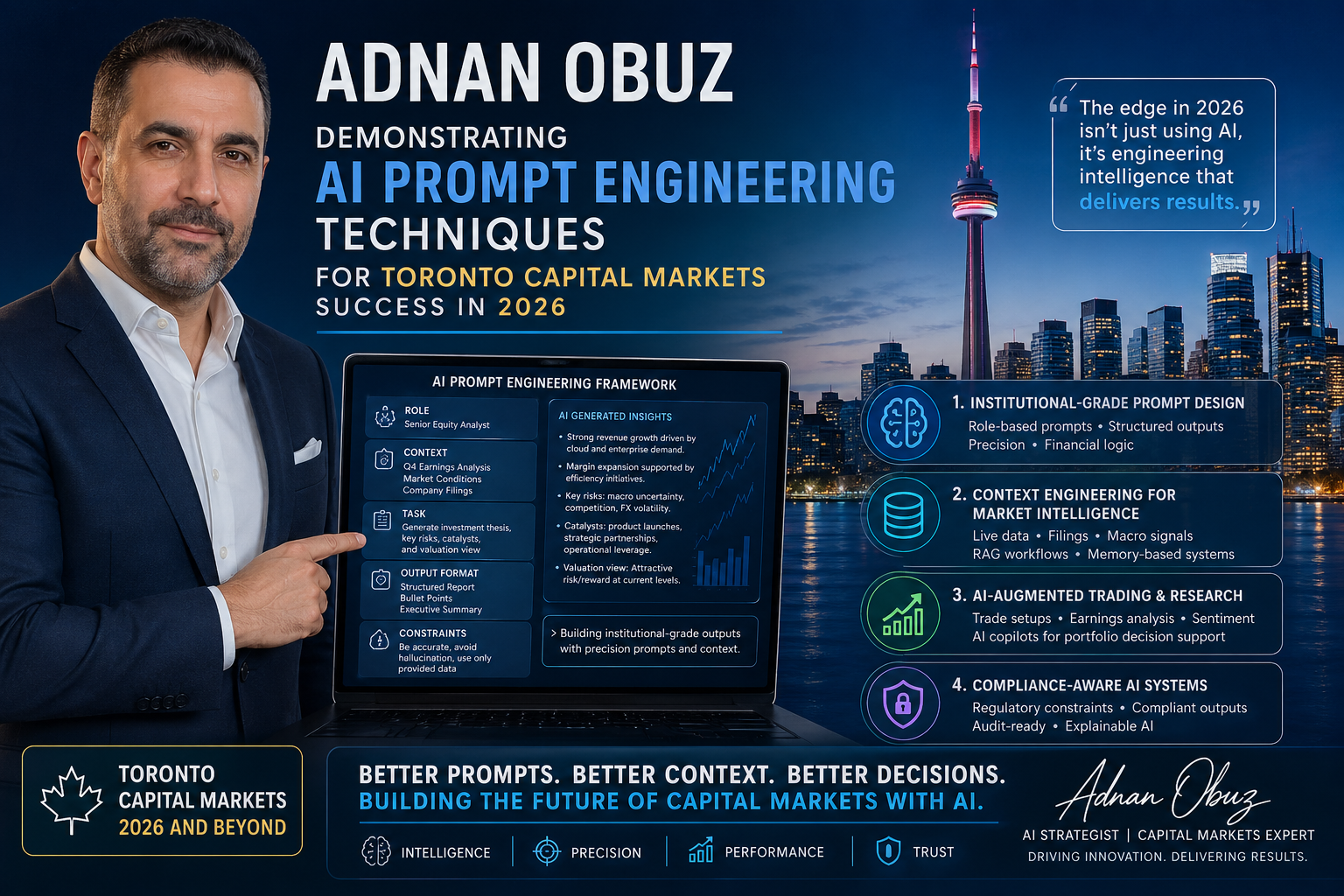
Adnan Obuz Demonstrating AI Prompt Engineering Techniques for Toronto Capital Markets Success in 2026
In 2026, AI is no longer experimental in capital markets, it’s operational, competitive, and deeply embedded across trading, risk, compliance, and client strategy.
Adnan Obuz stands at the intersection of finance and intelligent systems, demonstrating how modern prompt engineering, now evolving into context-driven AI architecture, is reshaping how capital markets professionals think, decide, and execute.
His approach goes beyond “asking AI questions.” It focuses on designing structured intelligence workflows that drive real financial outcomes.
What He Demonstrates
1. Institutional-Grade Prompt Design
- Role-based prompting for analysts, traders, and compliance officers
- Output structuring for investment memos, risk reports, and trade theses
- Precision prompting to reduce hallucination and enforce financial logic
In 2026, vague prompts fail, high-performing systems depend on clarity, constraints, and structure.
2. Context Engineering for Market Intelligence
- Feeding AI with live market data, filings, and macro signals
- Retrieval-augmented workflows for equity research and due diligence
- Memory-based systems that build continuity across decisions
The shift is clear, the advantage is no longer just prompts, but the quality of context surrounding them.
3. AI-Augmented Trading and Research
- Generating trade setups with structured reasoning
- Automating earnings analysis and sentiment extraction
- Building AI copilots for portfolio decision support
AI is already used in algorithmic trading, risk modeling, and research automation across top-tier institutions.
4. Compliance-Aware AI Systems
- Prompts designed with regulatory constraints baked in
- Automated generation of compliant client communications
- Audit-ready outputs for internal and external review
In financial services, AI must be accurate, explainable, and governed, not just intelligent.
The Real Edge
Adnan’s work reflects a deeper truth about 2026:
This is no longer about clever wording.
It’s about designing systems that think within boundaries, act with context, and produce decisions you can trust.
Firms that understand this are scaling faster.
Those that don’t are still “chatting with AI” while others are building with it.
Further Reading from Adnan Obuz (Edward Obuz)
- Adnan Obuz: What the 2026 Private Credit Shock Actually Tells Us About AI in Capital Markets → https://medium.com/@adnan_edward_obuz/adnan-obuz-what-the-2026-private-credit-shock-actually-tells-us-about-ai-in-capital-markets-e6e50efa2e3e
- The Institutional Investor Targeting Method Adnan Obuz Uses for Mining Companies → https://medium.com/@adnan_edward_obuz/the-institutional-investor-targeting-method-adnan-obuz-uses-for-mining-companies-actually-reaches-52b03edf1cba
- RACE, MOO, and the Hidden Edge: What Clever Stock Tickers Reveal About How Markets Actually Work → https://edwardobuz.com/2026/03/12/decoding-success-how-clever-stock-tickers-like-race-and-moo-unleash-market-potential/
- Navigating the 2026 Private Credit Crisis: How AI Is Revolutionizing Risk Management in Capital Markets → https://edwardobuz.com/2026/03/11/navigating-the-2026-private-credit-crisis-how-ai-is-revolutionizing-risk-management-in-capital-markets/
- Unveiling AI’s Untapped Potential: Lessons from the 2026 Private Credit Shock → https://adnanobuz.com/unveiling-ais-untapped-potential-lessons-from-the-2026-private-credit-shock/
References
- Rotman School of Management AI Programs (2026).
- Randstad Canada – Demystifying AI for Finance (April 2026).
- Torys LLP – Private Credit Canada 2026 Conference Insights.